


Page 59 - ISMCON souvenir 2021
P. 59
ISMSCON - 2021

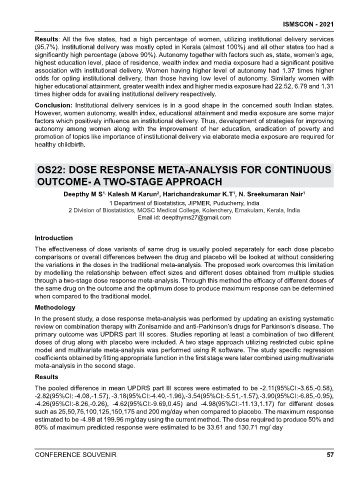
             Results: All the five states, had a high percentage  of women, utilizing  institutional  delivery  services
             (95.7%). Institutional delivery was mostly opted in Kerala (almost 100%) and all other states too had a
             significantly high percentage (above 90%). Autonomy together with factors such as, state, women’s age,
             highest education level, place of residence, wealth index and media exposure had a significant positive
             association with institutional delivery. Women having higher level of autonomy had 1.37 times higher
             odds for opting institutional delivery, than those having low level of autonomy. Similarly women with
             higher educational attainment, greater wealth index and higher media exposure had 22.52, 6.79 and 1.31
             times higher odds for availing institutional delivery respectively.
             Conclusion: Institutional delivery services is in a good shape in the concerned south Indian states.
             However, women autonomy, wealth index, educational attainment and media exposure are some major
             factors which positively influence an institutional delivery. Thus, development of strategies for improving
             autonomy  among  women  along  with the improvement  of her education,  eradication  of poverty and
             promotion of topics like importance of institutional delivery via elaborate media exposure are required for
             healthy childbirth.


              OS22: DOSE RESPONSE META-ANALYSIS FOR CONTINUOUS

              OUTCOME- A TWO-STAGE APPROACH

                      Deepthy M S  Kalesh M Karun , Harichandrakumar K.T , N. Sreekumaran Nair         1
                                    1,
                                                      2
                                                                               1
                                      1 Department of Biostatistics, JIPMER, Puducherry, India
                        2 Division of Biostatistics, MOSC Medical College, Kolenchery, Ernakulam, Kerala, India
                                               Email id: deepthyms27@gmail.com

             Introduction

             The effectiveness of dose variants of same drug is usually pooled separately for each dose placebo
             comparisons or overall differences between the drug and placebo will be looked at without considering
             the variations in the doses in the traditional meta-analysis. The proposed work overcomes this limitation
             by modelling the relationship between effect sizes and different doses obtained from multiple studies
             through a two-stage dose response meta-analysis. Through this method the efficacy of different doses of
             the same drug on the outcome and the optimum dose to produce maximum response can be determined
             when compared to the traditional model.

             Methodology
             In the present study, a dose response meta-analysis was performed by updating an existing systematic
             review on combination therapy with Zonisamide and anti-Parkinson’s drugs for Parkinson’s disease. The
             primary outcome was UPDRS part III scores. Studies reporting at least a combination of two different
             doses of drug along with placebo were included. A two stage approach utilizing restricted cubic spline
             model and multivariate meta-analysis was performed using R software. The study specific regression
             coefficients obtained by fitting appropriate function in the first stage were later combined using multivariate
             meta-analysis in the second stage.
             Results

             The pooled difference in mean UPDRS part III scores were estimated to be -2.11(95%CI:-3.65,-0.58),
             -2.82(95%CI: -4.08,-1.57), -3.18(95%CI:-4.40,-1.96),-3.54(95%CI:-5.51,-1.57),-3.90(95%CI:-6.85,-0.95),
             -4.26(95%CI:-8.26,-0.26),  -4.62(95%CI:-9.69,0.45)  and  -4.98(95%CI:-11.13,1.17)  for different doses
             such as 25,50,75,100,125,150,175 and 200 mg/day when compared to placebo. The maximum response
             estimated to be -4.98 at 199.96 mg/day using the current method. The dose required to produce 50% and
             80% of maximum predicted response were estimated to be 33.61 and 130.71 mg/ day


             CONFERENCE SOUVENIR                                                                               57

