


Page 34 - ISMCON souvenir 2021
P. 34
ISMSCON - 2021

                 Application of Meta Analysis in Health

                                    Research and Pitfalls


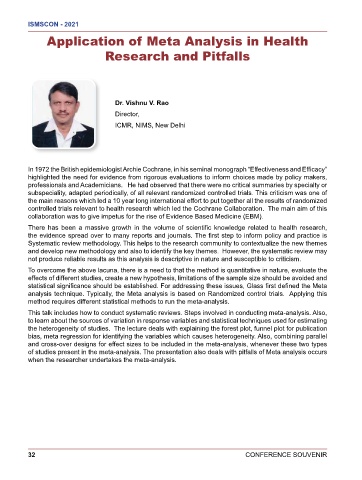
                                        Dr. Vishnu V. Rao
                                        Director,
                                        ICMR, NIMS, New Delhi


          In 1972 the British epidemiologist Archie Cochrane, in his seminal monograph “Effectiveness and Efficacy”
          highlighted the need for evidence from rigorous evaluations to inform choices made by policy makers,
          professionals and Academicians.   He had observed that there were no critical summaries by specialty or
          subspeciality, adapted periodically, of all relevant randomized controlled trials. This criticism was one of
          the main reasons which led a 10 year long international effort to put together all the results of randomized
          controlled trials relevant to health research which led the Cochrane Collaboration.  The main aim of this
          collaboration was to give impetus for the rise of Evidence Based Medicine (EBM).

          There has been a massive growth in the volume of  scientific knowledge  related to health research,
          the evidence spread over to many reports and journals. The first step to inform policy and practice is
          Systematic review methodology. This helps to the research community to contextualize the new themes
          and develop new methodology and also to identify the key themes.  However, the systematic review may
          not produce reliable results as this analysis is descriptive in nature and susceptible to criticism.
          To overcome the above lacuna, there is a need to that the method is quantitative in nature, evaluate the
          effects of different studies, create a new hypothesis, limitations of the sample size should be avoided and
          statistical significance should be established. For addressing these issues, Glass first defined the Meta
          analysis technique. Typically, the Meta analysis is based on Randomized control trials.  Applying this
          method requires different statistical methods to run the meta-analysis.

          This talk includes how to conduct systematic reviews. Steps involved in conducting meta-analysis. Also,
          to learn about the sources of variation in response variables and statistical techniques used for estimating
          the heterogeneity of studies.  The lecture deals with explaining the forest plot, funnel plot for publication
          bias, meta regression for identifying the variables which causes heterogeneity. Also, combining parallel
          and cross-over designs for effect sizes to be included in the meta-analysis, whenever these two types
          of studies present in the meta-analysis. The presentation also deals with pitfalls of Meta analysis occurs
          when the researcher undertakes the meta-analysis.


          32                                                                        CONFERENCE SOUVENIR

